


Tonys Roundtable
The talented sextet — nominated for ‘Mary Jane,’ ‘Days of Wine and Roses,’ ‘Purlie Victorious,’ ‘Appropriate,’ ‘Merrily We Roll Along’ and ‘Cabaret,’ respectively — sat down with THR ahead of the 77th Tony Awards.
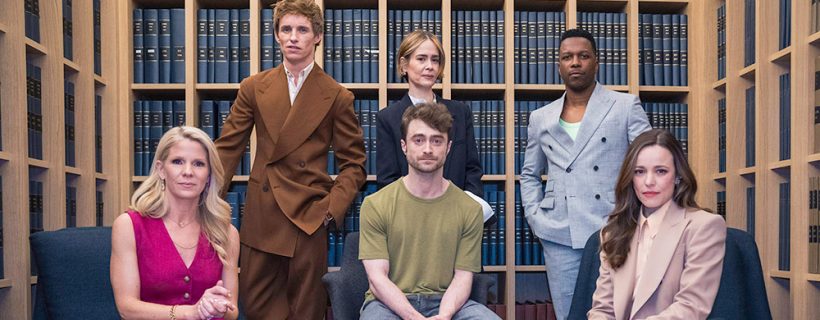
Ahead of the 77th Tony Awards, which will be held on June 16 at Lincoln Center’s David H. Koch Theater in New York City, The Hollywood Reporter gathered six of the 2023-24 Broadway season’s standout performers at PMC’s east coast headquarters for our annual Tonys Roundtable.
Joining us to discuss their paths to Broadway, Tony-nominated parts and pet peeves were two nominees for best actress in a play, Rachel McAdams (Mary Jane) and Sarah Paulson (Appropriate); best actor in a play nominee Leslie Odom Jr. (Purlie Victorious); best actress in a musical nominee Kelli O’Hara (Days of Wine and Roses); best actor in a musical nominee Eddie Redmayne (Cabaret); and best featured actor in a musical nominee Daniel Radcliffe (Merrily We Roll Along).
Three of them already have a Tony on their mantelpiece: O’Hara, 48, a longtime leading lady of Broadway musicals who has accumulated eight noms and won on her sixth for The King and I in 2015; Redmayne, 42, who was recognized for his work in Red in 2010, when he was last on the Great White Way, prior to becoming an Oscar-winning movie star; and Odom, also 42, who has been Broadway royalty since originating the role of Aaron Burr in the game-changing musical Hamilton, for which he took home a statuette in 2016.
Paulson, 49, and Radcliffe, 34, have, over the course of their careers, frequently moved between Hollywood and Broadway — she is best known for her many collaborations with Ryan Murphy, he for playing Harry Potter in eight blockbuster films — but neither had ever received a Tony nom prior to this year. Meanwhile, McAdams, 45, a movie star for 20 years, is nominated this year for her Broadway debut. (Her best-known films, Mean Girls and The Notebook, both from 2004, have recently been turned into Broadway musicals.)
The talented sextet discussed their very different paths to Broadway and to the parts for which they are now nominated; how they navigate the physical and emotional toll of performing a show eight times a week for months on end; their frustrations with the business side of showbiz, and with disruptive audience members; plus much more.
Before we discuss this season, I’d like to ask each of you to speak about what Broadway represented to you before you got here, and the journey that you took getting here. Daniel, you landed at the age of 11 in a little movie franchise, Harry Potter, and by 17 were here in Equus. You could have done a lot of things at that time. Why Broadway?
DANIEL RADCLIFFE My mom and dad had always taken me to the theater a lot, and so doing stage was always something that I wanted to do. I didn’t know that it would necessarily start that soon, but I was very happy that it did. Doing Equus was incredibly formative for me, because at that point, when I was towards the end of Potter, I didn’t know how the world was going to see me after those films were done. Between Equus and How to Succeed [in Business Without Really Trying, his second Broadway show], this place was giving me a chance to be something else and to find out who I was as an actor.
How to Succeed was your first musical on Broadway. Merrily is your second. What was your experience with singing and dancing before these shows?
RADCLIFFE I took singing lessons for the first time when I was on Equus because in the first scene of Equus, I sing advertising jingles, and I couldn’t do the tune of any of them. My singing teacher was like, “Everybody in the audience is over a certain age, and they know what these should sound like, so you really should hit these notes.” So I started working with him for that. How to Succeed and Merrily have been two of the best experiences of my life — but one every 10 years is a good rate for me because it’s hard!
Daniel, in Merrily you play Charley Kringas, who’s part of a trio of best friends within which there’s a duo of songwriters — he’s the lyricist — who grow apart, although we’re seeing it all happen backward. This is a Stephen Sondheim musical that had been done on Broadway only once before, 40-plus years ago, and at that time — as hard as it may be to believe for people who see what a success it’s been with you guys — it lasted just 12 days, and apparently, in a mirror of what was going on in the show, led to a rift between Sondheim and Harold Prince. Not everybody would sign up for a show with that history. Were you aware of it?
RADCLIFFE I became aware of it. My personal history with the production is that I saw it in 2013, Maria Friedman’s production in London, and so, for me, I’ve only ever known it as a show that works. I very, very rarely read something or see something and go, “Oh, I’m really right for this part,” but I did with that, particularly watching Damian Humbley, who’s incredible, do “Franklin Shepard, Inc.” There’s always been a part of my brain when I hear a lyrically intricate fast song that goes, “I have to try and learn that,” for no other reason than to amuse myself. So when the opportunity to do the show here came up, I read the script, and I was again going, “This character sits really well in my voice. I can hear myself saying these lines. It’s sounding authentic to me.” I’m happy to be corrected on this, but I don’t think there’s a ton in Sondheim’s canon that I am as well-matched for as this part. I’d been looking to do another musical for a long time, but the thing I learned from How to Succeed, which I loved so much, is that you need to love it to be doing a musical because it is, I think, the most demanding thing that I’ve ever done.
It’s a shame that Sondheim, who died in November 2021, just missed seeing that Merrily actually can work on Broadway. There’s actually been a whole wave of Sondheim shows doing very well on and off Broadway, of late.
It seems to me like all of your characters have nothing in common except for the fact that playing them must be a physical and emotional rollercoaster of an experience — and you did or do it eight times a week! Can you share how you prep and recover so that you can still function when you’re not onstage?
RADCLIFFE Similarly, I don’t feel like I’m as tired as I should be. I find the show incredibly energizing. People come back afterward and say, “Are you knackered?” I’m like, “No, I’m not. I’m really not.” That may have something to do with the structure of Merrily because it starts at their worst point, but we get happier, and happier, and happier, and we end with this beautiful, light, lovely scene. So hopefully the audience is getting some catharsis, as well as just being quietly devastated.
Daniel, I have to follow up about the song you mentioned earlier, “Franklin Shepard, Inc.,” the number in the show in which your character nukes his friendship with his songwriting partner, although you could argue that he’s reacting to it having already been nuked by the partner. People say that there’s something about Sondheim songs, especially patter songs like this one, that are uniquely vocally challenging. Have you found that to be the case?
RADCLIFFE I don’t think it is the hardest song of the show. I think the hardest song of the show is “Growing Up,” which Jonathan has to sing, and is a very, very slow, active number. I find those songs far harder. I would rather be doing something that is frenetic and fast and goes at a pace like that, where there’s a lot of stuff to think about and do. So I actually think it’s just a complete gift of a thing to get to do as an actor. It’s so much fun every night. I feel like I’m on drugs when I’m doing it. Yeah, I live in mild fear of that song every day, but it’s also really exciting.
Does your ability to handle the demands of these parts vary depending on specific days of the week?
RADCLIFFE It could go either way. It either feels like, “Oh, I’m back and I feel fresh,” or “I feel like I’ve never done the show before.”
With our remaining time, I’m going to give a few prompts and ask you to say the first thing that comes to your mind. To begin with: Excluding family, whose attendance at one of the performances of your show has meant the most to you?
RADCLIFFE Martin Short.
What’s the most unusual thing in your dressing room?
RADCLIFFE A small plastic basketball hoop that was left by Alex Edelman, who was in the show before ours. He said, “Do you want to keep it?” I was like, “Yeah, obviously!”
Eddie, there’s a lot of people that are getting smashed at your show, right? Is that an issue?
RADCLIFFE At Merrily, it’s been OK. I think being in a musical covers a lot — I’m sure stuff’s happening during those songs, but I can’t hear it. But since we’re here, my two favorites: On Equus, there was seating onstage, and I was onstage the whole time, and if I wasn’t in the scene I would just go back to sit on one of these four blocks — it was supposed to be my room at the hospital. And there was one night when I got to my block in the first scene that I wasn’t in, and two girls in the seats just started talking to me, just full voice, while Richard Griffiths and Kate Mulgrew were doing a scene behind me, just going, “Dan! Dan! Look up here!” It carried on through the whole first act. And then I was like, “I don’t need them to leave. But can they just go into the main auditorium so that they’re not just trying to speak to me through the show?” And then my other favorite audience member? I was doing Rosencrantz and Guildenstern Are Dead in London, and this dude came in, sat down, and, through Josh McGuire’s first monologue as Guildenstern, which is incredibly complicated, took out a footlong sandwich, wrapped in tin foil, unwrapped the whole thing, ate it in its entirety and fell asleep for the rest of the first act. But then in the second act, he was the most attentive audience member — jumped up at the end and clapped. I wanted to be like, “Wait, did you have a good time?” “Yeah. I had a dinner, had a sleep and saw half of a great show.”
If you could snap your fingers and make it so, what would be the ideal number of performances your show would offer per week?
RADCLIFFE I don’t want to make myself unpopular, but I like the grind.
Last one. If you could play any role on the stage that you have not played before — somebody’s listening — what would it be?
RADCLIFFE I’ll know it when I see it.


